MaxManager
Architecture
MaxManager is a polyglot system: one Compose application as the control surface, five native executables that do the persistent work on the device, and a Rust library behind a JNI seam for the operations where a shell round-trip per question was the wrong shape.
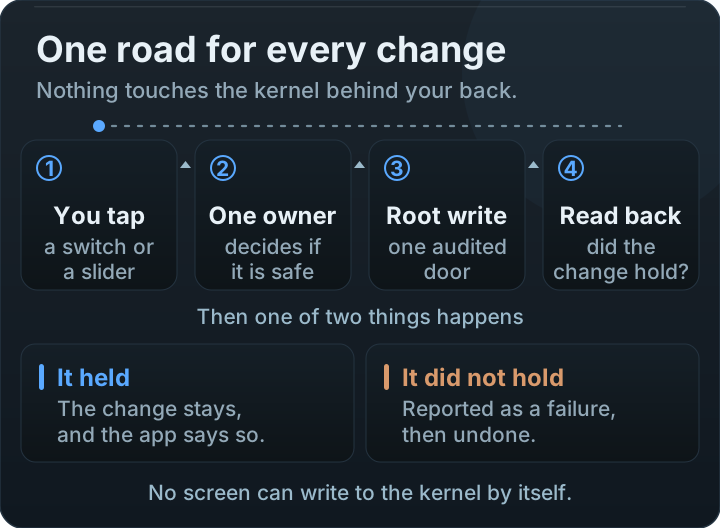
The four invariants
These are architectural, not stylistic — each is enforced by a test or a gate, not by convention.
| Invariant | Enforced by |
|---|---|
One write path. Every hardware mutation goes through HardwareControlArbiter; nothing else writes. |
core/hardware/ControlPlaneArchitectureTest.kt, plus the §6 gate that fails the build on a sysfs write inside ui/** |
| Capability before control. Nothing is surfaced until the platform proves the interface exists. | HardwareCapabilityResolver + the Atlas capability map |
One navigation spine. Routes exist in ui/navigation/MaxDestinations.kt and nowhere else. |
A static test that fails on a literal route string outside that package |
One design language. New UI is built from ui/design/, not improvised per screen. |
tools/design_tokens.py --assert, which fails on new hardcoded literals in ui/** and names the file |
Layers
┌─ ui/           53 destinations · 9 domains · design system · light/dark · 84 locales
├─ ui/viewmodel/ screen state and root-command orchestration (StateFlow) — never writes hardware
├─ core/hardware/ THE ARBITER · capability resolver · ownership · manual locks · per-app registry
│                 drift guard · read-back verification · repair executor · backends (CPU/GPU/ZRAM/charging)
├─ core/atlas/    discovery · capability map · route planner · adapters · route memory · safety policy
├─ core/maxai/    objective · planner · safety · learning · journal · insights · cadence
├─ core/jni/      6 bridges (probe · prop · scan · archive · context · predictor) → libmaxmanager_native.so
├─ core/platform/ app_status protocol · property reads (native first) · FPS · sensors · thermal reads
└─ core/privilege/ privilege levels: root + Shizuku, combined into one declared verdict
The single write path
ui/** → ViewModel → HardwareControlArbiter → RootFileAccess → kernel interface
                        │
                        ├─ journal the intent
                        ├─ resolve ownership (safety > per-app > manual > AI)
                        ├─ write, then read back
                        ├─ compare applied vs actual; attempt rollback on mismatch
                        └─ DriftGuard re-checks later for silent drift
RootFileAccess is the only root boundary. Reads have a layered path (native reader → IPC → file →
shell) precisely so that the fallback is explicit and not an accident.
Native layer
| Piece | Language | What it is |
|---|---|---|
sys.maxmanager-service |
C (14 components) | The main daemon: app loading, game preload, PID tracking, bypass charging, system profile, inotify, config, logging, startup |
sys.maxmanager-rianixiathermalcore |
Rust | Thermal policy daemon (see thermal.md) |
sys.maxmanager-profilesettings |
Rust | Chipset profiles (see profiles.md) |
sys.maxmanager-utilityconf |
Rust | Utility configuration |
sys.maxmanager-preloadbin |
C | Game library preloader (embeds vmtouch) |
libmaxmanager_native.so |
Rust | The JNI library: batched reads (probe), property reads without a shell (sysprop), storage scan, archive/zip, contextual engine, RL agent, digital twin, power predictor, log parsing |
The JNI packets have a published wire format in both languages (ProbePacket, PropPacket,
ScanPacket, ArchivePacket and their Rust twins), and tools/jni_symbols.py --assert checks the
contract: Kotlin/Java declarations against the Rust symbols in the built libraries, per ABI.
Cross-process ownership
The app and the daemons can both hold a view of the same physical knob, so ownership lives outside the
process (SharedHardwareOwnershipStore) with durable manual locks (ManualControlLocks). “Who owns
this control right now?” has one answer that survives a process restart, which is what makes a manual
choice stick.
Measurement as architecture
Two habits are load-bearing here, not decoration:
- Nothing claims a result without reading it back.
WriteVerificationandVerifiedControlexist because “we wrote it” and “it settled” are different statements. - Diagnosis is data, not prose.
DiagnosticCenterkeeps live problems;LogCodeGlossarywrites the meaning of every field inside the log file itself;DeviceBlueprintmakes a report reproducible;HardwareRouteHealthexplains why a control cannot be activated from facts alone.
What is hard about this design, honestly
- Cross-process state is genuinely hard. Ownership, drift and recovery all have a shared store behind them, and getting it wrong shows up as “my setting reverted” three screens later.
- Vendor divergence is the rule. Frequency units, OPP tables, and property names differ between chipsets; the adapters exist because a single code path cannot cover them.
- The safety list is a judgement. Fragment matching fails closed (it will refuse something safe rather than allow something dangerous) — that is a deliberate trade, not an oversight.