MaxManager
Max Atlas — making a feature work on this device
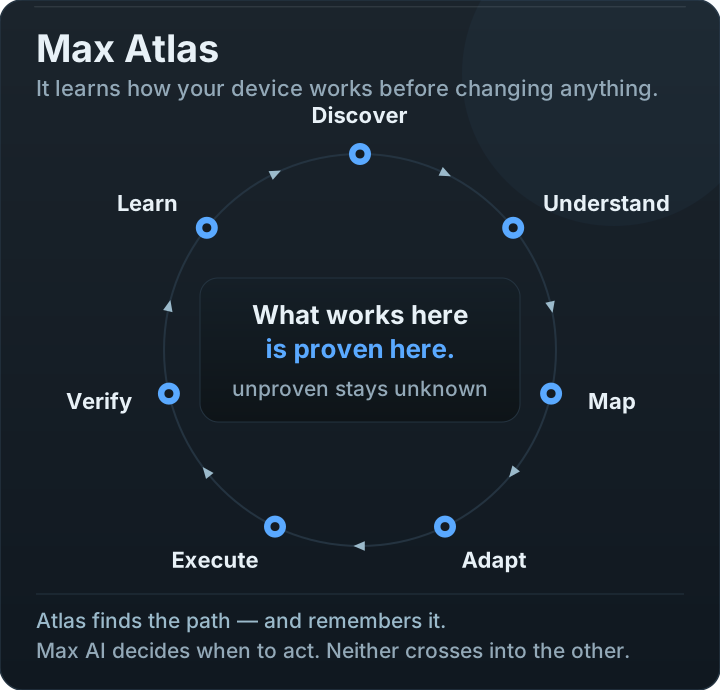
Atlas exists because “it works on my phone” is not a specification. Android devices present the same sounding interfaces with different names, different units, different writability, and different levels of honesty. Atlas is the system that finds out which of those is true here — and remembers it.
The cycle
| Stage | The question it answers | Owner in the code |
|---|---|---|
| Discover | What does this device actually expose? | AtlasDiscovery + AtlasBackendProvider |
| Understand | What do the numbers mean — identity and units? | AtlasDeviceIdentity + AtlasModels |
| Map | What may we do here, and what must we never touch? | AtlasCapabilityMap + AtlasSafetyPolicy |
| Adapt | How is this particular feature reached on this device? | AtlasAdapterRegistry + AtlasControlAdapter |
| Execute | Make the change — through the one write path | AtlasAdaptiveExecutor → HardwareRepairExecutor → the arbiter |
| Verify | Did it actually settle? | HardwareVerification + the confirmation window |
| Learn | What does this device remember? | AtlasRouteMemory + AtlasEvidenceStore |
Five design rules that produced the whole system
1. Discovery is bounded, and a limit is reported as a limit. A scan runs under a budget —
operations, entries, bytes, time (AtlasReadBudget). When a bound stops a scan, the report says a
limit stopped it, never “the device had nothing to say”. That distinction is the difference between a
diagnostic and a guess.
2. Absence must be proved. A failed read is not an absence. Only a successful listing that does
not contain a name proves that the name is not there — everything else stays UNKNOWN
(AtlasDiscovery.childrenOf). This is why the app can tell you “your device does not have this” with a
straight face: something had to prove it. The mirror case is just as important: a node that was listed
but could not be read is not an absence either — it is a measurement gap with its own name, because a
blocked parent-directory traversal looks exactly like an unsupported feature.
3. Unknown stays unknown. The capability map is a derivation, never a measurement — every input
comes from something that already established it. UNKNOWN is the honest default, and it is
deliberately not UNAVAILABLE.
4. Safety is a separate, higher answer. AtlasSafetyPolicy owns the reviewed never-touch list.
Matching is by fragment, on purpose, because vendors add members (trip_point_14_hyst,
watchdog_thresh) that a narrow list would let through: a false refusal costs one skipped knob and
names its rule; a false allowance costs the hardware protection it was meant to keep. Every rule
carries its reason, because “never write this” without a “because” is a superstition the next
maintainer deletes.
5. Only a verified write is a success. SUPPORTED requires that a write was read back and stayed
put through the confirmation window. Sending a command is not success; “it was written” is not “it
settled”. Everything else is recorded in its real state — FAILED_ROLLED_BACK,
DRIFTED_ROLLED_BACK, STATE_UNKNOWN, BLOCKED — and never filed as a vague “failed”.
The seven capability states
| State | Means | Evidence behind it |
|---|---|---|
SUPPORTED |
A reviewed route exists and a write was verified on this device | planner eligible + remembered verified outcome |
WRITABLE |
A reviewed route is eligible now; success not yet proven | planner eligible |
READ_ONLY |
The device answers reads; no write route is eligible | measured + readable |
NEEDS_ADAPTER |
The feature is visible; this build has no proven way to drive it | readable + no known route |
UNAVAILABLE |
Absence was proved by a listing | absence proved |
NEVER_TOUCH |
A reviewed rule forbids writing this interface | AtlasSafetyPolicy |
UNKNOWN |
Nothing measured, or nothing answered and absence was never proved | the honest default |
Where the knowledge comes from
AtlasCatalog— reviewed capability knowledge: for each interface, an anchor directory, an attribute name inside it, the unit, and how it is transported. This is the first line: knowledge we stand behind.AtlasCommunityBank— the second line of defense: a candidate catalog built from the interface vocabulary that open-source kernel-manager projects accumulated over years. Candidates are suggestions for a route, never permissions to use one.AtlasEvidenceStore— where cached evidence lives (app-private, atomic replace, bounded read).AtlasFreshness— evidence lifetime, which handles two different meanings of “old” that are usually conflated.AtlasFailureLedger— negative evidence with its own lifetime: a read that failed is a fact, and some failures are permanent for the process or the boot while others deserve a retry.AtlasRouteMemory— per-device route outcomes: what worked here, and what did not.HardwareDeviceOverlay— the third line, and the only one the owner writes. Adevfreqnode that answers with a frequency ladder but that no reviewed rule classifies is listed as unnamed instead of dropped, and the owner names its kind once (memory/storage). The overlay is a plain text file in the app’s own directory, so it can be copied to another device or sent with a report. Three rules keep it honest: a built-in rule always wins, graphics names are refused (a knob may not have two owners), and a name is stored only after the node was read back as a real frequency interface (MemoryUfsHardwareBackend.probe). A bad line is refused with its reason and never drops the rest of the file.
Memory and storage frequencies — a second surface Atlas owns
MemoryUfsHardwareBackend is the single owner of the non-graphics devfreq nodes. It enumerates
/sys/class/devfreq and classifies each node from observed vocabulary (dvfsrc, cpubw, memlat,
mif, ufshci, …) rather than from a per-device path table — a path such as
/sys/devices/platform/soc/112b0000.ufshci/devfreq/112b0000.ufshci is an address on one SoC and an
absent node on the next kernel. Then it proves the unit from the node’s own ladder, and reads the range
back after every write.
The screen writes min_freq / max_freq only, through the arbiter and with canonical keys
(mem_frequency:<device>, ufs_frequency:<device>), so no knob ever has two writers. Its profiles are
fractions of configurableMaxFreq — the ceiling the driver publishes now, not the catalog — because a
vendor thermal cap makes a catalog number impossible and it would then be recorded as a failure. Nothing
is invented: a one-step ladder is not a range, an unproven unit is read-only, and the memory-stall advice
(full avg10 ≥ 10% from PSI) is offered, never applied on its own.
When no rule names a node, the map says unclassified-devfreq-node-seen rather than “nothing
observed” — the node was observed, its kind is what is missing, and naming it is one tap in
Memory & UFS, not an update.
A node that was listed but answered nothing is a different gap with a different action:
devfreq-node-unreadable. It is shown under listed but unread with no teaching buttons, because
nothing about it was measured to teach. The same split exists at the class root: /sys/class/devfreq
missing is a measured absence (devfreq-root-absent — the kernel publishes no devfreq class), while
a root that exists and cannot be listed stays devfreq-root-unreadable and never claims absence.
Proving it without a device
Atlas carries its own evidence pipeline: AtlasFixtureRecorder turns one real run into a fixture,
and AtlasFixture replays that recording through the very same read interface. AtlasDoctor
then asks whether a replayed device still reproduces the report it came from.
That is how “needs device” stopped being a permanent excuse in this project — and why the discovery logic has tests that run anywhere.
Exporting the truth
AtlasSupportReport is a minimized report a user may choose to send, after the safe stages have
finished; AtlasReportExporter writes it to a file you hand over yourself. Nothing is uploaded on its
own. DeviceBlueprint is the read-only snapshot that makes a report reproducible, and
HardwareRouteHealth answers the why — for any control, from facts only — which is what the app
shows when it tells you a switch cannot be activated here.
The boundary with Max AI — a contract, not advice
| Engine | Its question | It owns | It does not own |
|---|---|---|---|
| Max Atlas | How can I work on this device? | which interfaces exist, which route reaches them, whether a write settled, what this device remembers | any performance goal, any priority, any “when” |
| Max AI | What should change now? | the objective, the value each knob should hold, when to act and when to leave the device alone | route selection, node discovery, direct writes |
Max AI says “I want the CPU ceiling at 60%”; Atlas answers “on this device that is written through
cpu_limits:<policy> with a clamped range, verified by read-back, and if it does not hold, no success
is recorded.” Neither crosses the line — Atlas does not tune, and Max AI does not discover hardware.