MaxManager
Verification — how the claims on this page are made
The commands quoted below run inside the private repository. This page is here so you can read what is measured and what is not — not to hand you a script you could run from here.
Every number in this repository is supposed to be re-derivable by someone who does not trust the author. This page is the map of how that works, what can be checked right here, right now, and — the part that matters most — what cannot.
The three layers
| Layer | Runs where | Needs | Answers |
|---|---|---|---|
| Contract gates | any machine with Python 3 | nothing else | Is the tree internally consistent? |
| Host tests | any machine with a C compiler and/or cargo | no SDK, no NDK, no phone | Do the pieces agree on their shared formats? |
| Device checks | a real phone | root, and a device | Does it actually behave? — listed honestly below as unverified here |
Layer 1 — contract gates
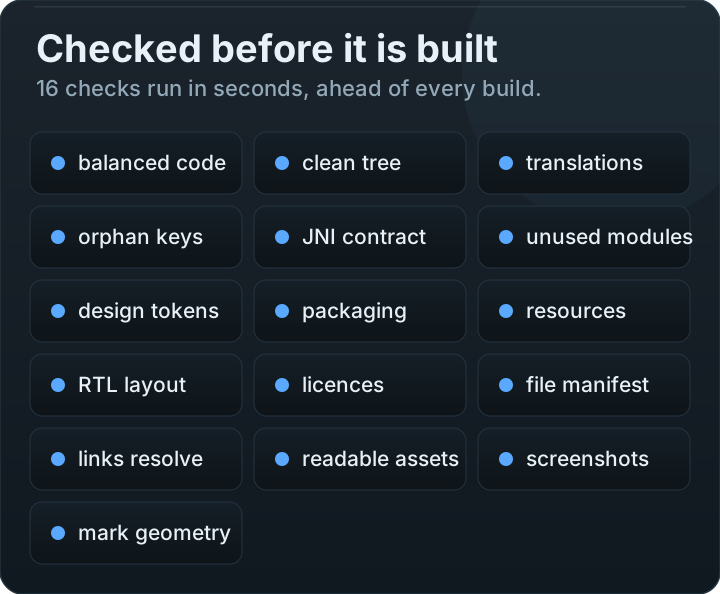
Thirty-three judgements run in CI before the NDK, Rust and R8 steps, so a broken tree fails in seconds instead of after minutes of native compilation. Sixteen are assertions; seventeen are the tools measuring themselves.
| Gate | What it refuses to let through |
|---|---|
kt_balance --assert |
Unbalanced braces, unterminated strings or comments, malformed XML |
code_health --assert |
Cleanliness violations, debt above its declared ceiling, undisclosed assets |
i18n_coverage --assert |
Wrong format specifiers, duplicate keys, folder/picker/locales_config drift |
i18n_coverage --prune all --assert |
Orphan translation keys (read-only: it reports, it never deletes) |
jni_symbols --assert |
Kotlin/Java ↔ Rust JNI signatures drifting apart (ADR-48) |
dead_modules --assert |
Rust/C modules that are built but have no user |
design_tokens --assert |
New hardcoded literals in ui/**, naming the file that added them |
bundle_contract --assert |
The 14 packaging contracts: version trio, daemon path, extraction completeness |
resource_compile --assert |
Invalid resources, judged by real aapt2 |
rtl_guard --assert |
Directional padding and icons that do not mirror |
license_audit --assert |
GPL code appearing anywhere in the release path |
source_manifest --assert |
The tree drifting from its declared file digest |
readme_assets --assert |
Broken or unsafe assets and links in this documentation, and the contextual icons: art outside the safe area of its grid, a glyph that leans on a font, an icon that appears on one language page only |
svg_review --assert |
Visual assets with text too small to read at phone width, panels clipped by the canvas, or a layout that is only right while motion runs |
screenshot_gallery --assert |
A screenshot grid on the front page that drifted from the folder it is generated from, a caption longer than its column, a route no screen answers to, or a PNG that is truncated, wrongly proportioned or over its size ceiling |
The four cheapest to run yourself — no SDK, no compiler, no device:
python3 tools/kt_balance.py --assert
python3 tools/code_health.py --assert
python3 tools/i18n_coverage.py --assert
python3 tools/readme_assets.py --assert
Why the self-tests matter. A checker that cannot fail proves nothing, so each tool is deliberately
broken and must name the rule it was supposed to catch. readme_assets --self-test, for example, feeds
its own SVG checker an illegal -- inside an XML comment, a stripped <script>, a keyTimes that
never reaches 1, and a stale banner number — and fails unless each is reported. svg_review --self-test
runs sixteen known-outcome cases, including the negative ones: an 8px label must be flagged, a clipped
tile must be flagged, and a glow that bleeds off the edge on purpose must not be.
screenshot_gallery --self-test runs thirty-five, including a truncated PNG, a file that is not an
image at all, a frame at the wrong ratio, and a grid someone edited by hand. And the negative case is
stated too: no capture existing yet is not a failure — the gallery reports the frames as pending,
because a gate that fails on missing coverage would be turned off within a week.
Layer 2 — host tests, no device
| Suite | What it pins |
|---|---|
archdaemon/tests/ |
The C daemon’s shared formats and CLI decisions, driven by the TSV/TXT fixtures |
fixtures/contracts/ |
The contract itself: 15 files measured from both sides — Kotlin produces some, C or Rust reads them, and vice versa (plus the index that explains each row) |
cargo test in binutils/, binprofiles/, thermalcore/ |
CLI decision tables, the property surface, and the PID decision core |
tools/test_atlas_jvm.py · tools/test_maxai_jvm.py |
The JVM-side shims for Atlas and Max AI |
fixtures/contracts/ is the answer to a real class of bug: a format that exists in Kotlin and is read in
C has no compiler watching it, so it breaks silently. Here the format is data, in one file, read by
both implementations — so a rename on one side fails the other side’s test.
Layer 3 — what needs a device, stated as needing a device
This is the part other projects round off. These are not verified by anything in this repository:
| Not verified here | Why | What would verify it |
|---|---|---|
| Actual hardware behaviour (a write settling on your chipset) | Needs the physical device; units and OPP tables vary by vendor | A run on the device — the app reports it per control, per device |
| SELinux policy correctness | There is no AOSP tree in this environment to run neverallow against |
Your tree’s neverallow pass, then dmesg \| grep -i avc after boot |
| Boot behaviour and the anti-bootloop guard | Needs a device that boots | The installer’s own boot counter, read from module.prop |
| Visual output: RTL mirroring on screen, motion, theme | Needs a renderer and a screen | The screenshots in screenshots/ |
| A signed release artifact | The signing password is not in this repository, by design | A CI run with the keystore secret present |
Where a claim cannot be verified here, it is written as “not verified in this environment” rather than as a pass. That sentence is a rule in this project, not a hedge.
What is proven about the build itself
- The Android app has been compiled from this tree and its release-variant unit tests have run green on CI, alongside R8/ProGuard on the release path.
- the module’s own installer script is checked against the artifact: the daemon arrives as an executable for the right ABI, and the module’s checksums verify after extraction.
- The published artifact is the flashable zip — no wrapper archive around it.
Provenance and licensing
Three documents carry this, and they are measurements rather than statements:
| Document | What it records |
|---|---|
PROVENANCE.md |
FILE · ORIGIN · LICENSE · STATUS · ACTION for every third-party-derived file |
AUTHENTICITY.md |
A similarity measurement against the GPL sources that were removed — generated by tools/upstream_similarity.py, not written by hand |
THIRD_PARTY_NOTICES.md |
The components that do ship (Apache-2.0, BSD-3-Clause) with their notices |
license_audit.py --assert fails the run if GPL code reaches the release path. That gate is why the
attribution sections are specific about which file is a copy and which is an independent
reimplementation.
Known issues
The project keeps its own defect list — measured entries, not a wishlist — in
KNOWN_ISSUES.md, and the delivery log with its failures and rejected tries in
HANDOFF.md. Both are part of why the engineering record is public.